Bonus or Burden? What It Means to Love a Partner with Children as a Childless Woman
On stepchildren, a father wound, and life after an unfulfilled longing for a child – a conversation with Jemma
by Katharina | Podcast: Alles da, nur Ella nicht – Surviving Without a Child
KATHARINA
Some conversations stay with you. This is one of them.
Jemma was a guest on my podcast once before – back then, she spoke about her journey through infertility: five years of trying, of treatments that didn’t work, of a marriage that slowly shifted, and ultimately of the courage it took to let go of a life that no longer felt right. You’ll find that first episode linked in the show notes – do listen, if you don’t yet know Jemma’s story.
This time, I invited her back because so much has changed. Jemma now lives in Ghent, Belgium, with a new partner – and has become part of a blended family she never planned for: her partner has two children, aged 14 and 16, who move between two households on a week-on, week-off basis. What that means when you carry an unfulfilled longing for a child of your own, how old wounds can suddenly crack open again, and what it feels like to find yourself in a role you never chose – that is what Jemma talks about in this conversation. Honestly, thoughtfully, and with a warmth I deeply admire.
Settle in. This one is worth it.
KATHARINA
It’s so lovely to have you back. How are you today?
JEMMA
I’m well – a little stirred up, a little nervous about this second episode. But also glad to be here, yes.
KATHARINA
Wonderful. For everyone who hasn’t heard your first episode, would you mind giving a brief sense of where you’ve come from?
JEMMA
Of course. My story begins with an unfulfilled longing for a child. My ex-husband and I spent five years trying to conceive – first without medical support, then two years in fertility treatment: IUI, IVF, ICSI, all of it. None of it worked. I never became pregnant, not once, throughout all of those years.
It was a time when I had to fight very hard – not only with the longing itself, but with feelings and old patterns that surfaced because of it. I couldn’t shape my identity the way I’d hoped, and that was deeply confronting – for me personally, and for my relationship with my ex-husband. I remain grateful to him to this day. We were able to part in love, and we are still friends.
KATHARINA
May I ask – did the end of that relationship have something to do with the fertility journey?
JEMMA
Not explicitly – it wasn’t the deciding factor. But we had grown apart over those years. The longing for a child had been so dominant that we’d lost sight of ourselves as a couple.
The turning point came during a trip I took alone. It showed me that what I truly wanted, deep down, was possible – that it wasn’t a fantasy, but something liveable. I no longer wanted to stay where I was: not in that house, not in that city, not in that job. I needed distance and space to find out who I really was, stripped of everything I’d constructed around myself.
And then there was the exhibition – it released something in me that I no longer wanted to carry.
KATHARINA
Will you tell us a little about the exhibition? I was fortunate enough to see it – I think it was the final evening, and we fell into each other’s arms in tears.
JEMMA
Yes! I remember that moment so well – I was absolutely sobbing. (laughs)
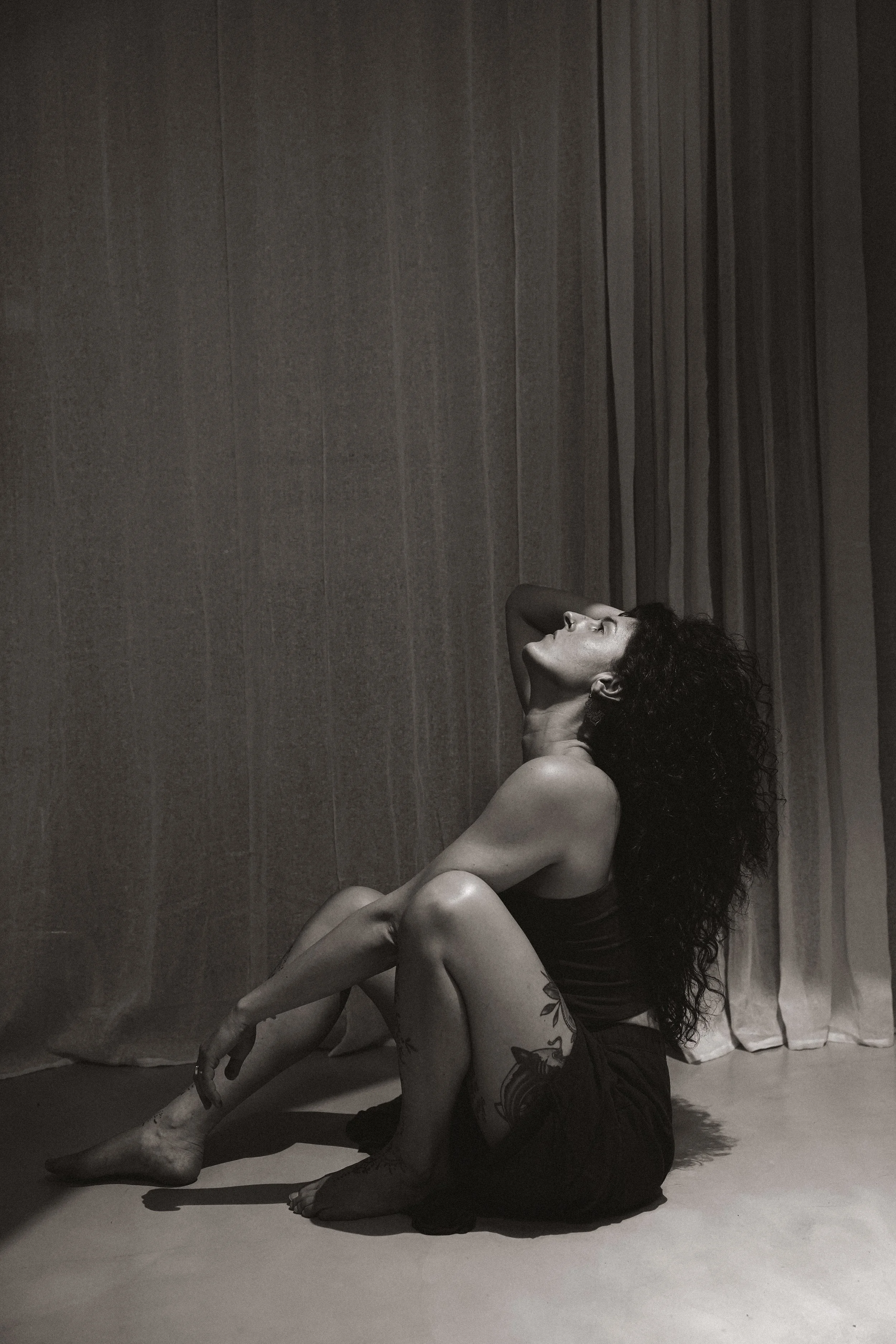
The exhibition is called Manushya – a Sanskrit word meaning something like “being human” or “humanity”. It’s a photography project about involuntary childlessness, which I created together with my stepsister, who took all the photographs. Rather fittingly – and we only noticed this afterwards – it took us just over nine months to make.
We exhibited sixteen works, accompanied by audio recordings in which I read aloud from my fertility diary. The project draws on moments from my own story, but it also raises questions that reach beyond infertility – questions about what it means to be human.
What moved me most was the openness it created. I had felt so isolated and alone with this subject for so long – and then to see how many people, women and men alike, were touched by it, how many extraordinary conversations took place. It truly drew me out of that isolation.
The Manushya exhibition can be experienced online: manushya - A doorway into the world of involuntary childlessness — Welcome ♥
You now live in Ghent with a new partner who has two children. What went through your mind when you found out he was a father?
JEMMA
Honestly, in the first moment – nothing at all. I hadn’t given any thought to a relationship at that point. And when an interest did begin to grow, it simply wasn’t an obstacle for me. Which was surprising, because I’d always said: a man with children – no thank you. That was firmly at the bottom of the list, right where the red entries go. (laughs) But in that moment, I didn’t question it. It simply was what it was.
KATHARINA
When did you first realise that the situation was stirring something in you?
JEMMA
About a month after I moved in. We were all ill at home – flu, colds, everything at once. And in that moment, I watched how my partner cared for his children. That tenderness, that attentiveness. And something rose up in me: This is what fatherhood can look like. I had wished for that – for myself, in my own childhood.
That was the first time I was truly confronted with my own wounds. Not the longing for a child – but my father wound. That was a very, very wide-open door.
KATHARINA
Did you share that with your partner?
JEMMA
I sat with it first, until I understood what it was actually about. I’m sure I was difficult to be around in the meantime. (laughs) But once I knew what was underneath it, I sought the conversation – because it matters to me. We live with the children, and that brings up reactions and behaviours that we simply wouldn’t have as a couple on our own. When the other person is in the dark and doesn’t know what’s going on, it’s unsettling for both of you. Communication has always been at the heart of our relationship – so I had to bring it out.
KATHARINA
How did the children receive you? They’re 14 and 16 now – a maternal role was probably neither expected nor wanted.
JEMMA
That was something I addressed very early on, both with my partner and with myself: I am not a bonus mum, a stepmum, or any kind of mum-plus. They have their mother, and that is as it should be. My role is clear: I am my partner’s partner. I support him and the children in everyday life, as much as I’m needed – but my function is defined. That was important to me, to keep my position clear in my own mind.
The first meeting was nerve-wracking – I was far more anxious than I’d expected. We arranged it so that I came over in the evening, when everyone was already home, in their own space, their safe space. I was the guest. That felt right for all of us.
Now, nearly a year and a half in, both relationships are very much their own. I find it easier to fall into conversation with the daughter – there are more natural points of connection. But what I notice with both of them is that the relationship breathes: sometimes it’s closer, sometimes there’s more distance – and often there’s no particular reason for it. People move towards and away from one another; that’s simply how it is. With teenagers, that push and pull is especially pronounced – it belongs to that stage of life. I try to accept it without judgement. And I take something away from every day, regardless of how it went. It is enriching in a way I hadn’t known before.
KATHARINA
That sounds beautiful. How do you manage the rhythm of it – a week with the children, a week without?
JEMMA
I always need a little time for the switch. I think we all do – it’s an adjustment for everyone. In the beginning it was particularly challenging, because I had come to know my partner as an individual first; I hadn’t met his children alongside him. So getting to know him in his role as a father was an entirely new dimension. I discovered sides of him I hadn’t seen before.
What was genuinely hard was not allowing myself, at first, to acknowledge how demanding it all was. I kept thinking: you chose this, so it needs to be fine. You need to show up. But I had no experience of relationships with children in them. I only knew the exclusive intimacy between two people.
Here, attention and energy are shared across more than one person. In theory I understood that completely. In practice, there were moments when I felt hurt or angry without being able to name why – until I realised: it wasn’t about the children at all. It was about me. About not feeling seen. Not feeling heard. About the sense that other needs take precedence over mine.
KATHARINA
How did your partner respond when you raised it?
JEMMA
It was still difficult. Because on the other side comes the thought: I can’t meet everyone’s needs. I’m letting someone down. That creates its own dynamic. Talking about it helps – but it doesn’t dissolve the pain instantly. You know what it’s about, and yet that knowledge doesn’t stop you from feeling hurt.
The truly difficult part was finding a way to communicate that was honest but didn’t place the blame with him. That is a balancing act that has taken a great deal of practice, and still does.
KATHARINA
Is there a moment that has stayed with you particularly?
JEMMA
Yes, one very specifically. I had left the house one morning without saying a word – because something had hurt me. As the day went on, I thought about it and said to myself: this isn’t fair on the children. They have nothing to do with this.
So I went back in the afternoon and apologised. I said: I’m sorry I left this morning without saying anything. I’m not doing well at the moment. Something has hurt me and I need to tend to that. And I want you to know that it has nothing to do with you.
The daughter said: “Oh, is that why Dad was in a bad mood today?” And I thought – if I hadn’t said anything, she would have assumed it was because of her. That moment showed me how important it is, not only to acknowledge to yourself how you’re feeling, but to actually say it out loud.
And then, on top of that, she mentioned she was quite good at arguing. I told her I’d never learned how – that conflict felt like danger to me, like the loss of love. So she showed me. We practised arguing together, like a little improvisational theatre. (laughs)
That was one of the most beautiful experiences I’ve had. What can come of it when you share yourself honestly and stay open to the other person – it’s extraordinary.
KATHARINA
How do you handle teenage moods? They really do inhabit their own world.
JEMMA
It genuinely depends on the day. There are days when I’m clear and calm, when I can hold on to the rational thought: these are teenagers, they have hormones, I know exactly what that’s like from my own experience. And there are days when none of that works.
What took me a long time to work out was where parenting ends and simply living together begins. That line is incredibly difficult to see. In the beginning, I often made myself invisible, stayed in the background, and was then frustrated because I hadn’t set my boundaries clearly.
There was a moment that showed me how important it is to hold your own ground. During a row between one of the children and my partner, something was said in the heat of it – a verbal jab that was directed at me as well. In that moment I said nothing, because I know that words don’t land when emotions are running that high. But later I found a quiet moment alone with them and said: I’m sorry if I’ve given the impression that it’s acceptable to speak about me that way – because it isn’t. I understand you were frustrated, and I hope you find a different way to express that. And that was that. It hasn’t happened since.
What I’ve learnt from my partner: in emotional moments, nothing gets through anyway. So wait for the right moment. Be brief and clear. And hold your boundary. It is what it is today, and it will be what it is tomorrow. If it changes, that is my decision to make.
KATHARINA
How are you today with your own unfulfilled longing – especially now that children are part of your daily life?
JEMMA
The longing for a child is no longer an active part of my life. It doesn’t accompany me in the way it once did. But it has moved through many different phases over the past year and a half – not the question of children yes or no, but more subtle things. Am I even allowed to speak to certain things, when I haven’t had children of my own? Is my perspective heard?
I was once sitting at a table where women were talking about how women without children always seem to have the best advice for mothers. It took me a while to digest that. And then I asked myself: what would be the point of stepping into that conversation? To defend my sense of self? Or to genuinely understand what lay behind it for them? I took it with me quietly and let it go.
There were also phases when I was genuinely at my wit’s end and asked myself: why do people have children at all? That was the overwhelm of confronting my own inner landscape – the children simply made things visible that were already there.
KATHARINA
And now?
JEMMA
Now these thoughts still pass through sometimes – the mental arithmetic of when a child would be born if… They pass through and move on. They no longer sink their teeth in. They’re not thoughts that drive my actions or fill my time. They remind me how deep this subject goes. But they no longer govern me.
And for that I am deeply grateful. During the active years of trying, I could not have imagined a life without that pain, without that longing. It felt so integral that it seemed impossible it would ever shift. To see now what freedom can grow from it – that is a gift.
KATHARINA
Do you have any advice for people who find themselves in a similar situation – falling for a partner who already has children?
JEMMA
I can only offer what I’ve learnt from my own experience.
First: clarify expectations. What does your partner expect of you – and what do you expect of yourself? Which role can you take on, and which do you actually want? That conversation needs to happen early, because it saves an enormous amount of friction later.
Second: look honestly at what’s happening inside you. I learnt that anger was my primary emotion for a long time, because it was familiar – I knew how to move within it, how to express it. What lay beneath was grief and fear. So really ask yourself: what am I actually feeling? Not the story I’m telling myself to keep my self-image intact – the truth.
Third: make space for yourself. Moments when you are simply yourself, outside of the dynamic. We should all do this in any relationship – but here it matters even more. Because only a version of you that has been looked after can truly show up for others.
And then: have the conversation. Go beyond your own shadow. For what matters to you. It won’t always be easy – it takes courage – but it is worth it.
KATHARINA
And finally – what do you do professionally, and how can people find you?
JEMMA
I live in Ghent and I work as an energy and bodywork practitioner. I work with people who are at a turning point in their lives – people who sense that things cannot continue as they have been, who may have analysed and understood a great deal, and yet find themselves stuck. Who cannot seem to break their patterns, or who keep returning to the same place.
My work is trauma-informed and body-oriented. It’s about truly arriving in the body and in feeling – finding safety within yourself, becoming able to meet your own inner world. It’s not a talking session; it’s two hours of bodywork. Working with the fascia, with acupressure points, with whatever the body reveals. Going into the actual experience: where am I blocking? What helps me open to my own interior?
You’ll find everything you need at manushya.life.
KATHARINA
Jemma, thank you from the bottom of my heart. Not only for this conversation – which was open, honest, and genuinely moving – but for sharing your story again. This is not a subject many people speak about so freely. And that is precisely why it matters so much.
I’m certain this will reach people who need it. And I really must come back to Ghent soon.
JEMMA
You are always welcome. ♥